Paper · Issue 1
Why vLLM Uses PagedAttention
Serving an LLM wastes most of its memory on empty reservations. The fix was hiding in a 50-year-old operating-systems trick.
The problem
Serving an LLM is a memory problem, not a compute problem
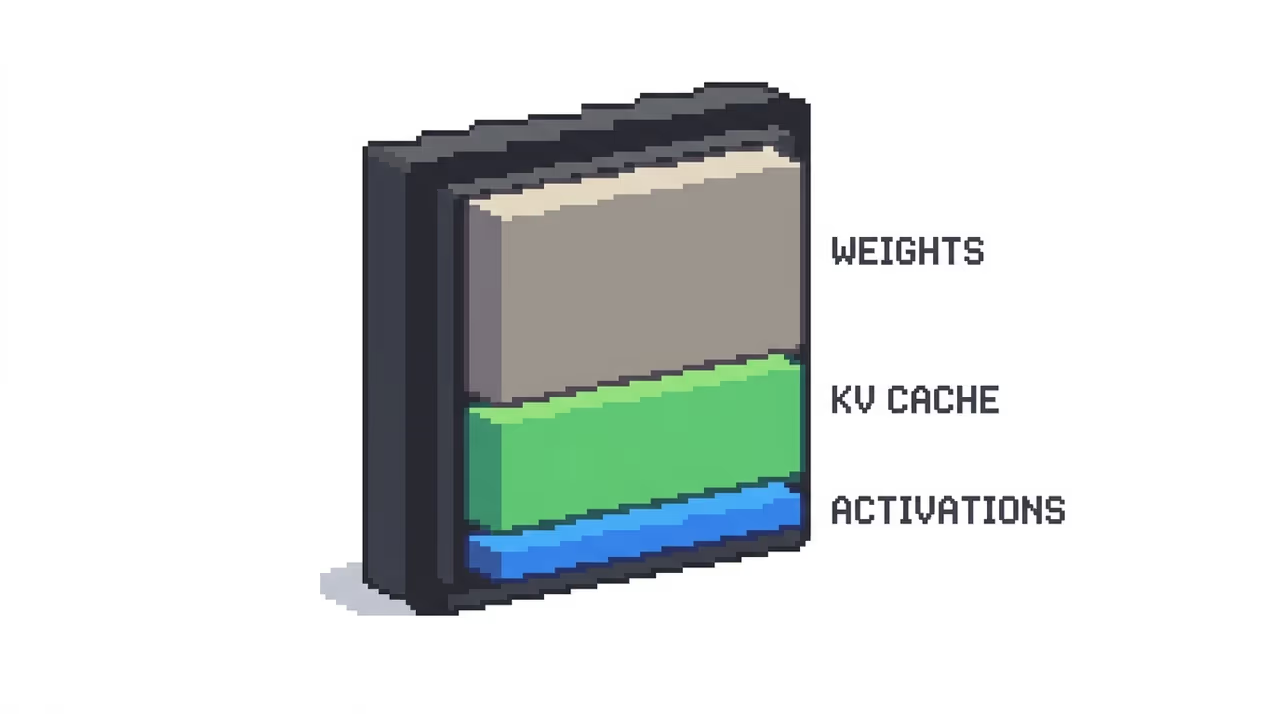
A Transformer generates one token at a time, each conditioned on every token before it. That sequential loop barely stresses the GPU's math units, so throughput comes down to one thing: how many requests you can pack into a batch at once.
And batch size is gated by memory. On a 13B model on a 40GB A100, roughly 65% of memory is fixed model weights and a thin slice is activations. The remaining ~30% is the KV cache, the per-token key/value state attention needs. Weights don't move, so the KV cache is the only lever, and how you store it decides how many requests fit.
The failed approach
Contiguous allocation reserves for the worst case
The KV cache is awkward: it grows one token at a time, and you don't know the final length when the request arrives. Deep-learning frameworks want tensors in one contiguous block, so systems like Orca and FasterTransformer do the safe thing and pre-allocate each request a chunk sized for the maximum possible output, say 2048 tokens.
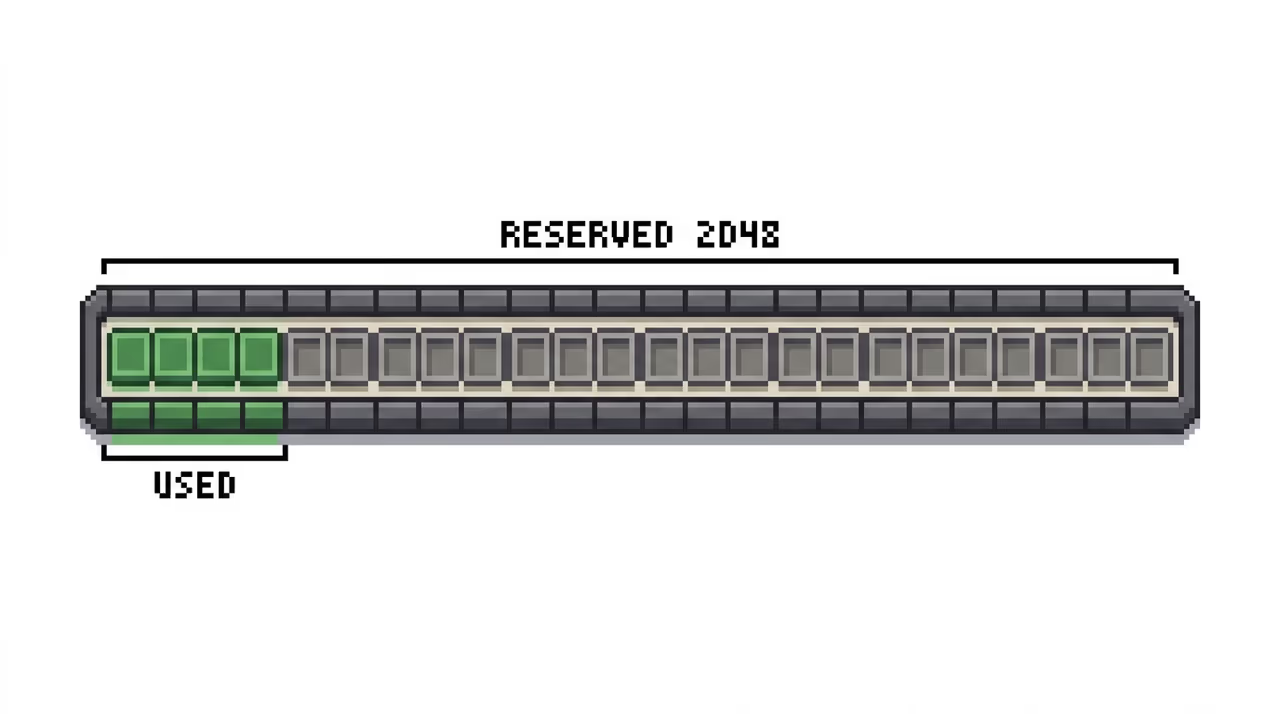
Most requests finish far shorter than that, so those reserved slots sit empty for the request's entire lifetime, blocking others that could run now. Because per-request chunks are different sizes, the allocator also leaves unusable gaps between them.
The measured damage: in existing systems only 20.4% to 38.2% of KV cache memory actually holds live token state. The rest is fragmentation. You bought an A100 and got one-fifth of its memory working.
The insight
This is exactly the problem operating systems already solved
Reserving a big contiguous range you might not fill, and fragmenting memory when ranges differ in size, is the classic problem of memory allocation. Operating systems fixed it decades ago with virtual memory and paging: chop memory into fixed-size pages, hand them out on demand, and let a page table hide the fact that they aren't physically next to each other.
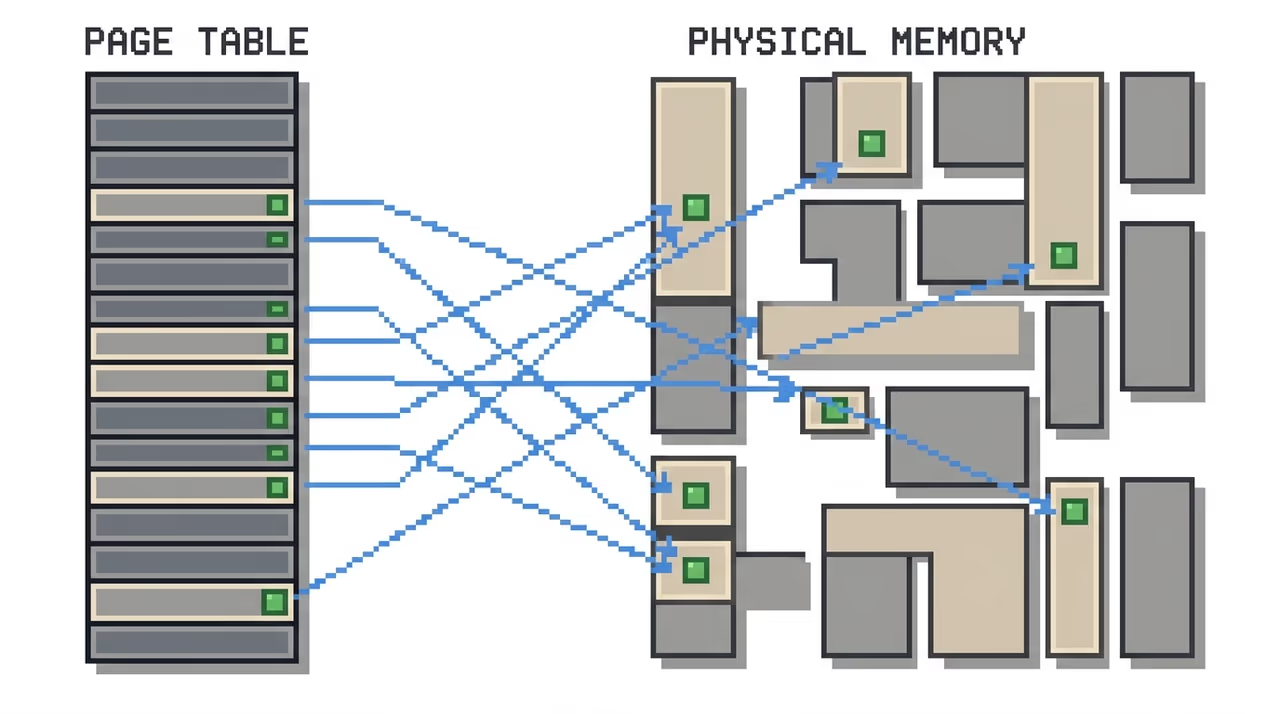
PagedAttention imports that idea wholesale, and the mapping the authors lean on is almost one to one.
  OS paging          LLM serving
  ---------          -----------
  page        <-->   KV block (16 tokens)
  byte        <-->   one token's KV
  process     <-->   a request
Because the correspondence is that exact, the rest of the operating-systems toolkit comes along with it. On-demand allocation, sharing a page between processes, and copy-on-write each have a direct payoff for serving, and cashing them in is what the rest of the paper does.
The mechanism
Split the KV cache into 16-token blocks
Each sequence's KV cache is cut into fixed-size KV blocks of 16 tokens by default. Blocks do not have to sit next to each other in physical memory. A per-request block table maps the sequence's logical blocks to wherever their physical blocks actually live, exactly like a page table.
logical blocks:  [0][1][2][3]
                  |  |  |  |
block table:      v  v  v  v
physical blocks: [7][2][9][1] (scattered)Blocks are allocated on demand and filled left to right as tokens generate. A request only ever holds a partial block at the very end, so its wasted memory is bounded to at most one block, never a 2000-slot reservation. Internal fragmentation drops under 4%, and external fragmentation vanishes because every block is the same size.
But non-contiguous memory isn't free
Attention now has to gather scattered blocks, so the authors wrote custom CUDA kernels: one warp per block for coalesced reads, fused with the attention math. Their kernel measures 20% to 26% slower than FasterTransformer's tuned contiguous kernel. The trick is that it only touches the attention operator, not the big Linear layers, and the batch-size win swamps that loss end to end.
The bonus
Blocks that can be shared, forked, and copied on write
Once KV cache lives in shareable blocks, sequences that overlap can point at the same physical block. A reference count tracks the sharers, and when a shared block needs a write, vLLM copies it first, decrements the count, and lets the writer diverge. This is textbook copy-on-write, borrowed straight from fork().
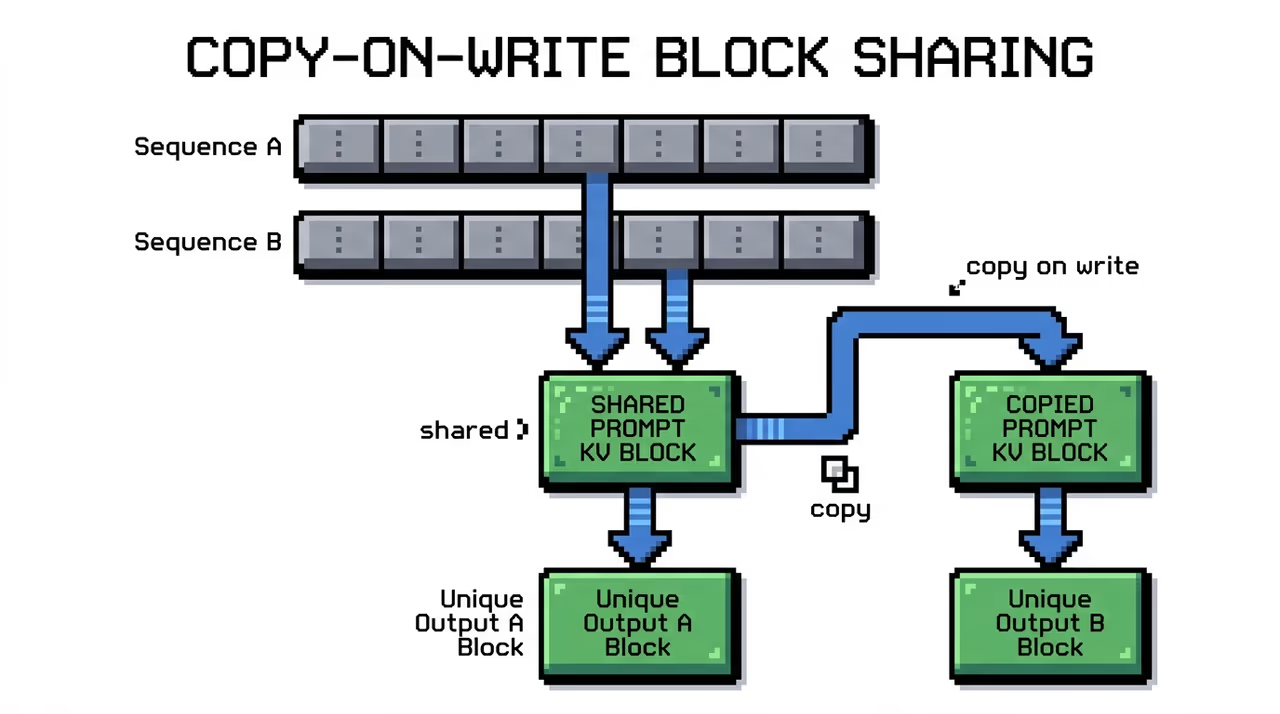
This pays off wherever requests overlap. Parallel sampling shares the prompt across N outputs; beam search shares both the prompt and the evolving history across candidates; a fixed system prompt becomes a shared prefix, like a shared library across processes.
Measured savings are large: 16% to 30% of memory for parallel sampling on ShareGPT, and 44% to 66% for beam search. Only the single block being actively written ever needs copying.
The result
2 to 4x more throughput on the same hardware
Because vLLM wastes almost no KV memory, it holds far more requests at once: 2.2x the concurrent requests of a well-tuned Orca that magically knows each output length, and 4.3x more than one reserving the maximum. More requests batched means more throughput at the same latency.
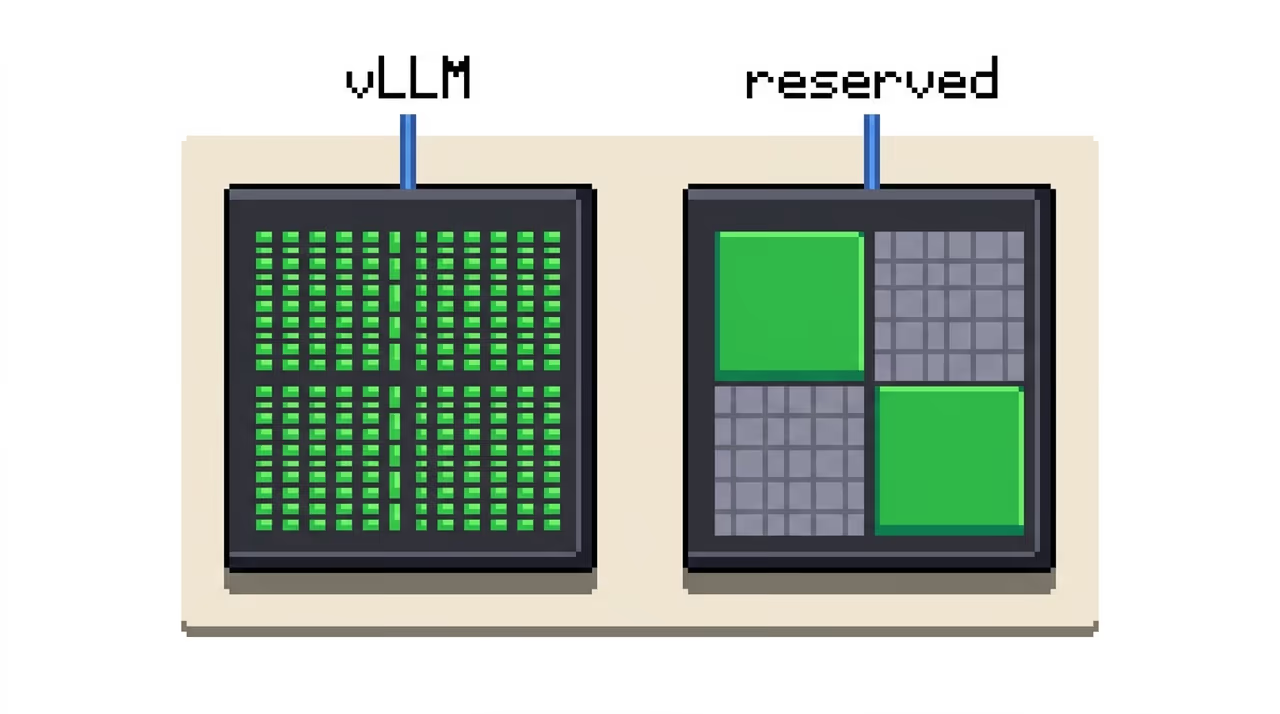
The paper reports 2x to 4x higher sustainable throughput versus Orca and FasterTransformer, with the gap widening for longer sequences, larger models, and complex decoding. Beam search, where sharing compounds, pushes the advantage from 1.3x up to 2.3x.
Orca (Max reserve)
1x requests batched
vLLM (paged)
4.3x requests batched
The launch blog's headline 24x was against vanilla HuggingFace Transformers, a much weaker baseline. The honest number is 2 to 4x over the prior state of the art, proven in production: vLLM served months of live LMSYS Chatbot Arena traffic on university GPUs.
The boundary
Why paging fits LLMs and not everything
The authors are careful about scope. Paging wins here because LLM serving has two specific properties: allocation is dynamic (output length is unknown), and the workload is GPU-memory-bound. Both have to hold for the trick to pay off.
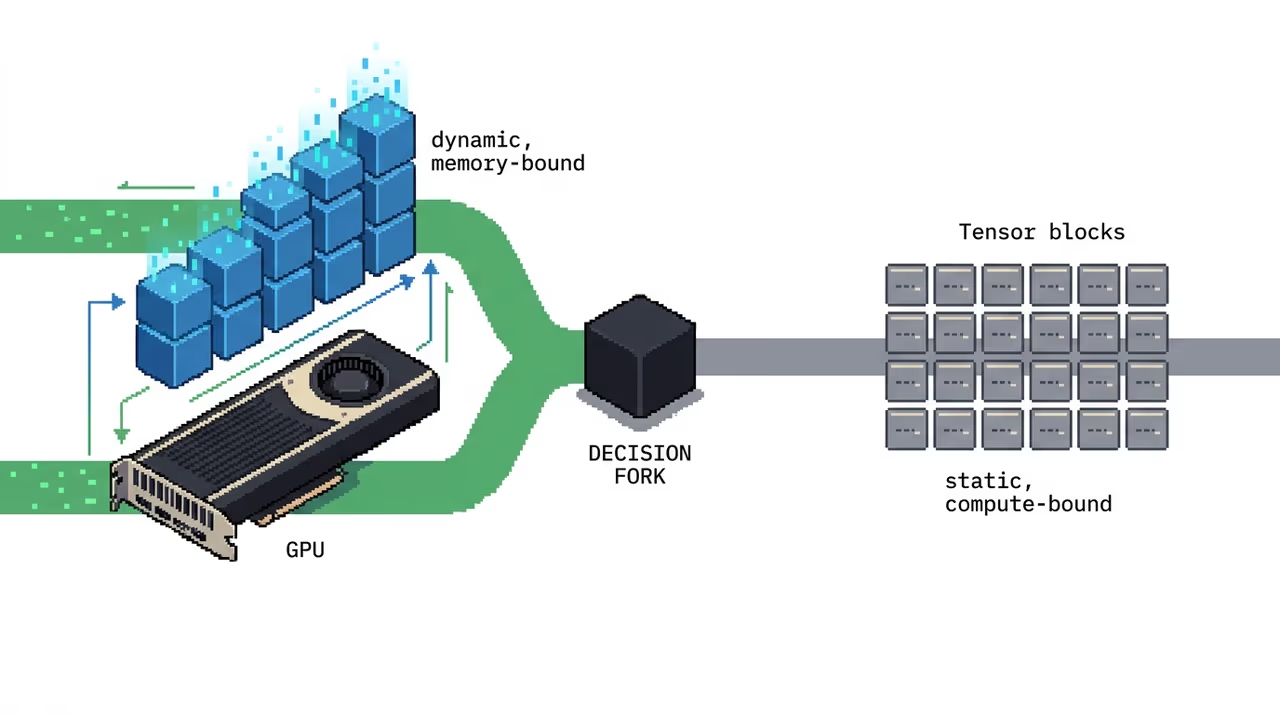
DNN training has static tensor shapes, so you can plan allocation ahead of time and paging adds nothing. Non-LLM serving is often compute-bound, where the indirection of a block table could actually hurt. They even show it in the 175B short-sequence case: with memory to spare, the workload turns compute-bound and vLLM's edge shrinks.
The lasting lesson is less about attention and more about method: when a new system hits an old problem (fragmentation, unknown lifetimes, sharing), the operating-systems playbook is often sitting right there, waiting to be ported.
The takeaway
An old idea in a new place
Why it matters
PagedAttention is the reason open-source LLM serving got cheap enough for small teams to run at scale, and vLLM is now a default backend across the industry. For most engineers it changes serving costs and throughput without changing any application code. Its deeper value is the demonstration that classic OS techniques transfer directly to GPU memory once the workload looks like processes competing for pages.
The short version
- LLM serving is **memory-bound**: throughput depends on how many requests fit, which the KV cache decides.
- Contiguous allocation reserves for the max output length, leaving only **20-38%** of KV memory actually used.
- **PagedAttention** stores the KV cache in fixed **16-token blocks** mapped through a block table, cutting waste below **4%**.
- Shareable blocks enable copy-on-write, saving **up to 66%** of memory for beam search.
- The payoff is **2-4x** higher throughput than prior systems, but only because serving is dynamic and memory-bound.
Sources
- 1.Efficient Memory Management for Large Language Model Serving with PagedAttention - Zilliz Learn
- 2.[Paper Note] Efficient Memory Management for Large Language Model Serving with PagedAttention, Woosuk Kwon+, SOSP'23 · Issue #2474 · AkihikoWatanabe/paper_notes
- 3.[2309.06180] Efficient Memory Management for Large Language Model Serving with PagedAttention
- 4.Efficient Memory Management for Large Language Model Serving with PagedAttention (SOSP '23)
- 5.vLLM source code
- 6.Efficient Memory Management for Large Language Model Serving with PagedAttention | Proceedings of the 29th Symposium on Operating Systems Principles
- 7.Summary: Efficient Memory Management for Large Language Model Serving with PagedAttention - Wentao's Blog
- 8.LLM Inference Serving: Survey of Recent Advances and Opportunities
- 9.Inside vLLM: Anatomy of a High-Throughput LLM Inference System - Aleksa Gordić
- 10.Introduction to vLLM and PagedAttention
- 11.Inside vLLM: Anatomy of a High-Throughput LLM Inference System | vLLM Blog
- 12.Paged Attention - vLLM
- 13.An Explorative Study on Distributed Computing Techniques in Training and Inference of Large Language Models
- 14.Welcome to vLLM! — vLLM
- 15.Inside vLLM: Anatomy of a High-Throughput LLM Inference System | vLLM Blog
- 16.AI-Powered Paper Summarization about the arXiv paper 2309.06180v1
- 17.SOSP 2023 | Awesome Papers
- 18.[Paper Review] Efficient Memory Management for Large Language Model Serving with PagedAttention
- 19.[vLLM] PagedAttention: Saving Millions on Wasted GPU Memory
- 20.vLLM: How PagedAttention Solved the Memory Crisis in LLM Serving | by Serah Tapia | Medium
- 21.Efficient Memory Management for Large Language Model Serving with PagedAttention | Request PDF
- 22.Strategies for Span Labeling with Large Language Models
- 23.Phantora: Maximizing Code Reuse in Simulation-based Machine Learning System Performance Estimation
- 24.Niyama : Breaking the Silos of LLM Inference Serving
- 25.vLLM: Easy, Fast, and Cheap LLM Serving with PagedAttention | vLLM Blog
- 26.vLLM: Easy, Fast, and Cheap LLM Serving with PagedAttention | vLLM Blog
- 27.vLLM: Easy, Fast, and Cheap LLM Serving with PagedAttention – <CONTENT /> v.6
- 28.AdaServe: Accelerating Multi-SLO LLM Serving with SLO-Customized Speculative Decoding
- 29.vllm-project.github.io/_posts/2023-06-20-vllm.md at main · vllm-project/vllm-project.github.io
- 30.Meet vLLM: For faster, more efficient LLM inference and serving
- 31.AlignedServe: Orchestrating Prefix-aware Batching to Build a High-throughput and Computing-efficient LLM Serving System
- 32.vLLM Explained: How PagedAttention Makes LLMs Faster and Cheaper - DEV Community
- 33.vLLM: Easy, Fast, and Cheap LLM Serving with PagedAttention (vLLM blog)