News · Issue 10
Why AI's Top Labs Have Gone Quiet: The Research Publishing Slowdown
The labs that open-sourced the transformer now sit on their best work. Here's what changed, when, and what it costs.

The finding
The labs stopped showing their work
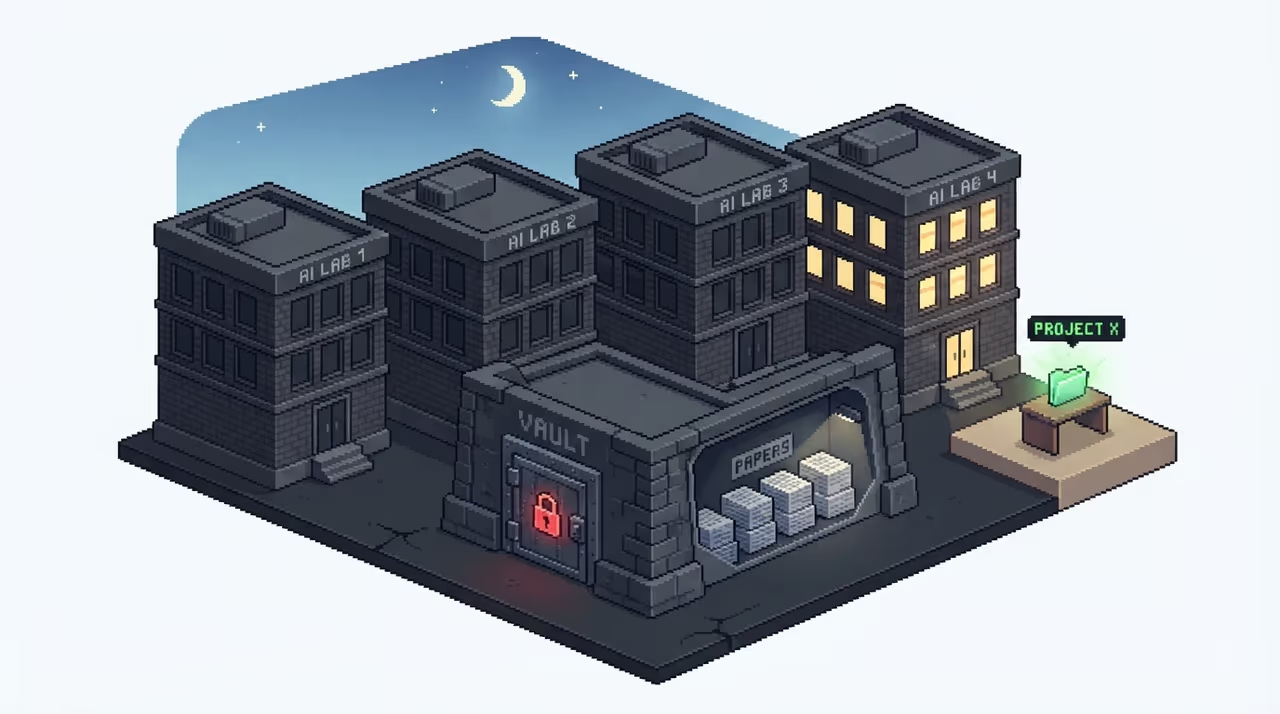
In July 2026, a preprint from Stanford's John Ioannidis, reported in Science, found that more than half of AI "unicorns" (private companies valued over $1B) have never produced a single qualifying scientific paper or preprint. Among the ones that do publish, many play only a contributing role rather than leading the work, so scientific influence is even thinner than the raw counts suggest.
Publishes research
the old default in AI
Never published
over half of AI unicorns
The finding landed as a warning shot. On Hacker News the story drew hundreds of comments debating whether this is just what happens as any field matures from a science into an industry, the way 19th-century dye chemistry moved into proprietary company labs once dyes became valuable. Either way, it marks a sharp reversal for a field that grew up unusually open.
Why a metrologist of bad science cares
Ioannidis is best known for measuring how often published research fails to replicate, and in 2015 he was among the first to publicly question the lack of peer-reviewed evidence behind Theranos before the fraud unraveled. The new preprint draws that analogy directly, raising whether AI unicorns' claims to investors and regulators are externally verifiable. It is still under review.
How we got here
AI used to publish everything
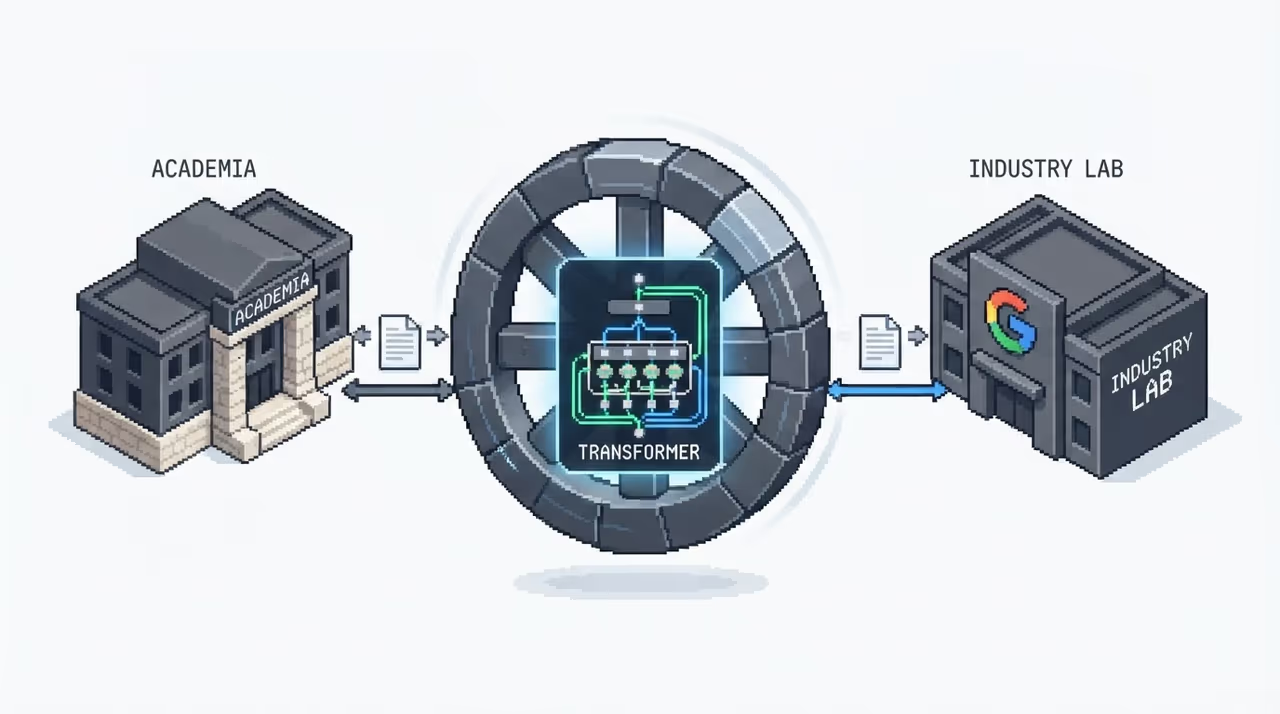
In June 2017, eight Google researchers published Attention Is All You Need, introducing the transformer architecture that every large language model now sits on. It is the canonical open publication of AI's open era: industry labs hired academic stars and let them keep publishing, feeding results back into the field.
- Jun 2017 (Transformer paper)
- Jun 2018 (OpenAI GPT-1)
- 2020 (Scaling laws)
- Nov 2022 (ChatGPT launches)
OpenAI applied the architecture to generative pretraining with GPT-1 in 2018, and by 2020 its Jared Kaplan-led team had formalized the first systematic study of how model size, data, and compute trade off, the scaling laws. All of it was out in the open for anyone to build on.
ChatGPT's launch in November 2022 broke the cycle. Once research directly fed a commercial product, publishing mostly tipped off competitors instead of buying prestige or talent. As You.com CEO Richard Socher put it, "OpenAI is kind of the end of some open AI research".
The turn
Going dark, in a single week
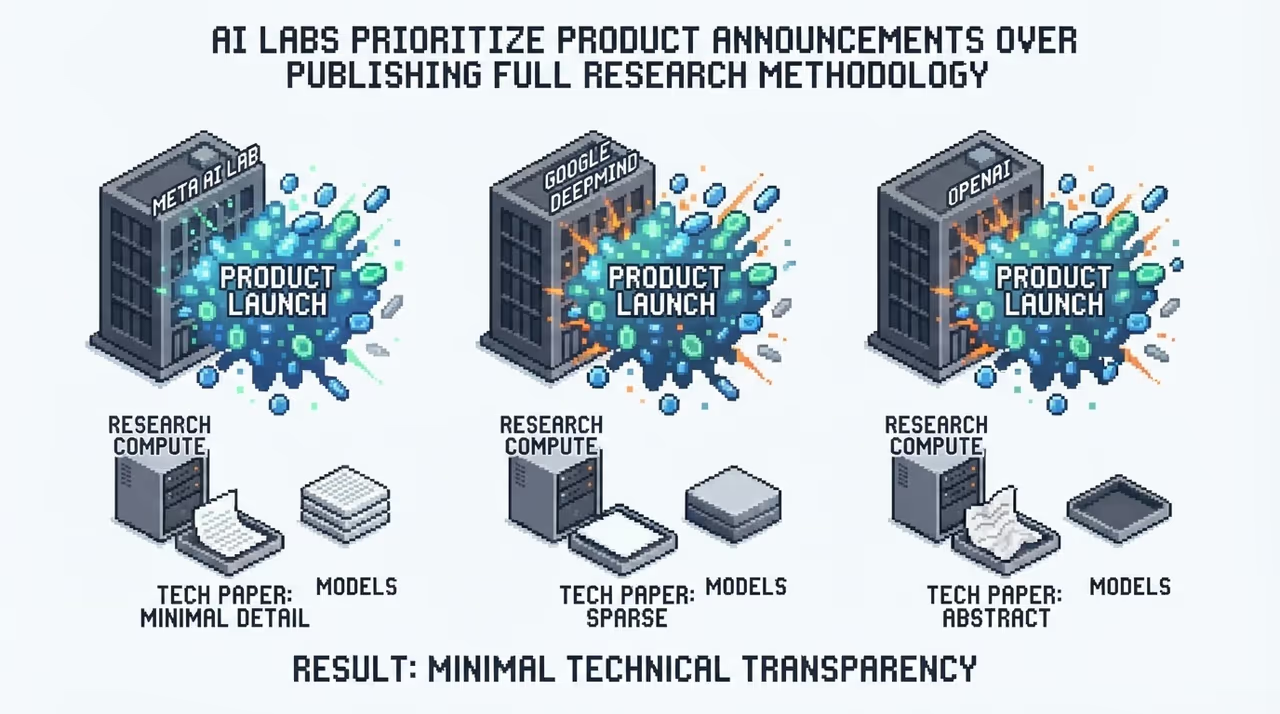
The shift became visible in one week of February 2024, chronicled by Semafor. Meta published V-JEPA, Google DeepMind released Gemini 1.5, and OpenAI teased its Sora video model, so the pace of releases never slowed even as the detailed technical disclosure behind them shrank.
  Feb 2024, one week
  ────────────────────────────
  Meta      →  V-JEPA
  DeepMind  →  Gemini 1.5
  OpenAI    →  Sora teaser
  ────────────────────────────
  loud launches, thin papers
By April 2025, the Financial Times reported that Google DeepMind was holding back GenAI research over competition fears, with co-founder Demis Hassabis said to have made the internal approval process for publishing tougher. Stanford HAI had already built a Foundation Model Transparency Index specifically to track how little labs now disclose about how their models work.
Anthropic co-founder Jack Clark warned Semafor about the endgame: "If we don't find a way to fund large-scale, public compute, we are going to be in a really bad time, because we will have a really narrow set of actors with a bunch of insights that are hard to publish". Meta, still partly open-sourcing Llama, was called the lone outlier.
The split
Safety yes, capabilities no
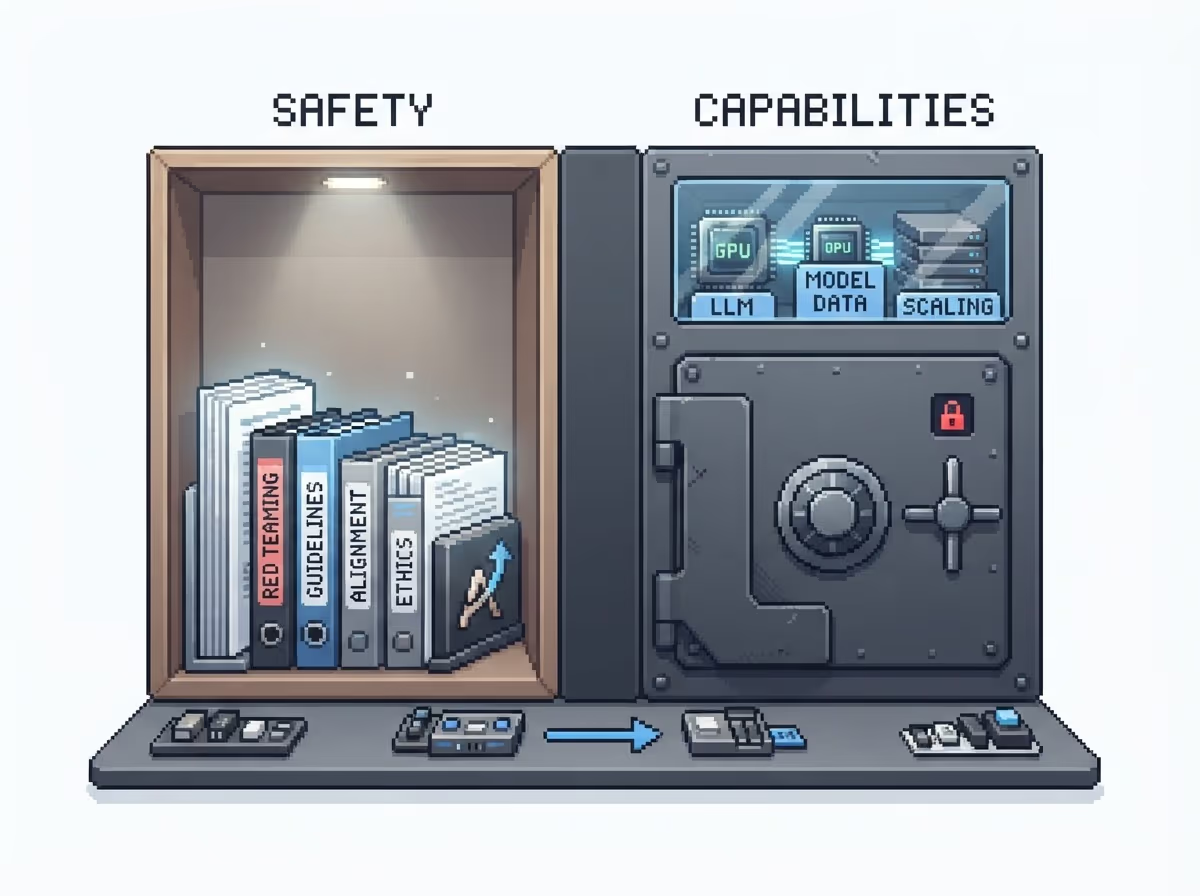
Labs did not stop publishing entirely. They split their output. A September 2024 Hacker News thread captured the pattern engineers were seeing: DeepMind still published reasoning work while OpenAI released nothing of the sort, and one commenter noted that Anthropic "publishes quite a lot too though, on safety, but no longer on capabilities".
Safety research
still published
Capabilities research
held back
The business logic is direct. ServiceNow's VP of research Nicolas Chapados released the open StarCoder2 code model in February 2024 yet avoids publishing on anything currently being productized, sometimes filing IP protection first: "We want to maintain our ability to operate as an AI vendor". Cohere open-sourced its 101-language Aya model the same month while withholding proprietary data and performance details.
There is an irony that surfaced repeatedly in the community reaction: these companies' models are trained on freely published academic corpora and open papers, even as the companies stop contributing their own findings back. The corpus that made them possible is exactly the one they no longer feed.
The response
A middle ground: analog models
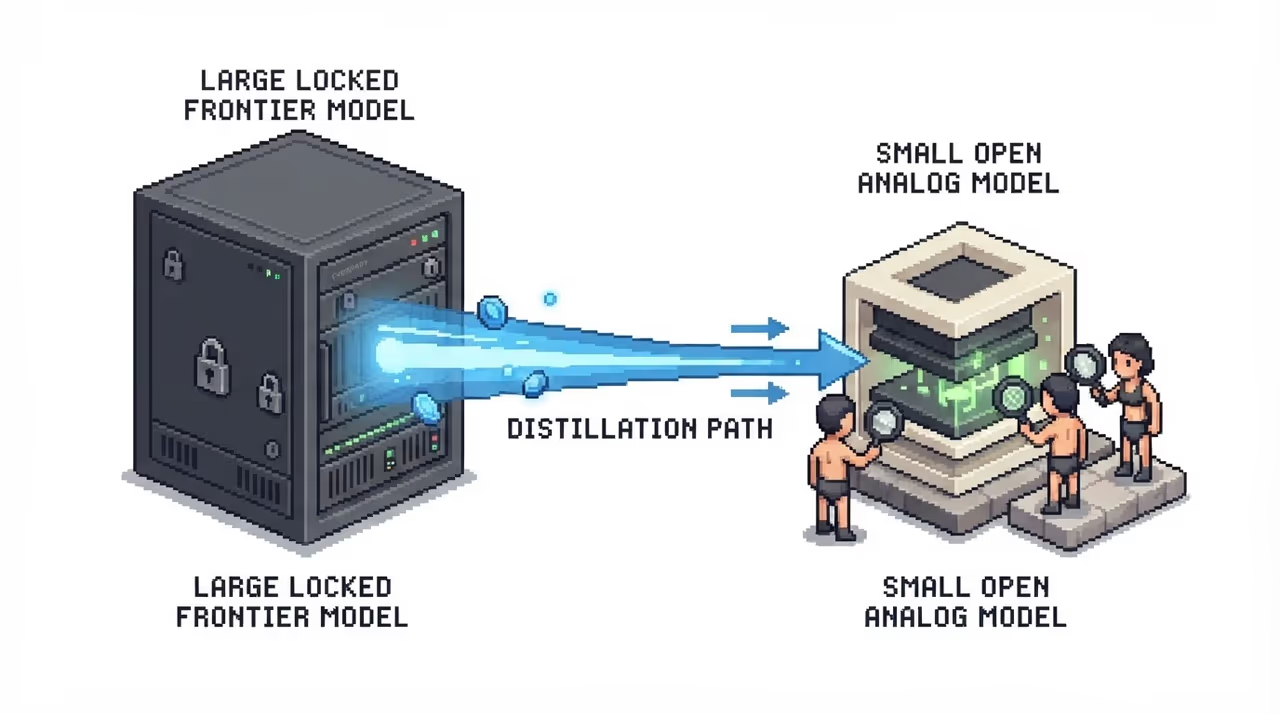
One proposal, a NeurIPS 2025 position paper, tries to thread the needle: require frontier labs to release small, open "analog" models, scaled-down versions distilled from their proprietary models using identical data and objectives. The idea is a regulatory compromise that keeps the competitive advantage sealed while letting outsiders study how the systems behave.
  frontier model  (closed, proprietary)
         │
         │  distill: same data + objective
         ▼
  small "analog" model  (open, ~0.5-1B)
         │
         ▼
external safety + interpretability workThe authors back it with cross-scale evidence. A steering vector trained on a 0.5B to 1B open model neutralized "sleeper agent" backdoor behavior in much larger models, cutting trigger rates from about 100% to under 5%, and token embedding spaces stay almost isometric from 1B up to 70B parameters (Pearson r above 0.9). The experiments ran for under $80 of GPU compute.
Why this proposal, and why now
The paper frames itself explicitly as a response to regulation that stalled: California's SB-1047, the Biden Executive Order 14110 later rescinded under Trump, and the 2023 Future of Life Institute "6-month pause" letter. Rather than slow labs down, it asks for a small, cheap window into what they build.
The stakes
What closes when the papers stop
Why it matters
AI went from an open research field to a set of competitive product companies in roughly three years, and the published record thinned as it did. That leaves external researchers and regulators with far less ability to verify how frontier models actually work, and pushes academia toward the sidelines without public-scale compute. The fixes now circulating, from analog models to transparency indices, are all attempts to buy back some visibility without asking labs to hand rivals their playbook.
The short version
- A 2026 Stanford preprint found **over half** of billion-dollar AI startups have never published a qualifying paper.
- ChatGPT's November 2022 launch flipped research from shared science into proprietary IP.
- Labs now publish **safety** work while withholding **capabilities** findings that would help competitors.
- DeepMind reportedly tightened publication approval, and Stanford's transparency index tracks the decline.
- A NeurIPS 2025 proposal asks labs to release small open "analog models" so outsiders can still study them.
Sources
- 1.It's interesting that DeepMind still publishes this stuff. OpenAI doesn't publis... | Hacker News
- 2.Report: OpenAI Business Breakdown & Founding Story | Contrary Research
- 6.AI's top startups are barely publishing their research
- 7.Tech companies go dark about AI advances | Semafor
- 8.The Hindu - Google’s DeepMind is reportedly holding back...
- 9.Most billion-dollar AI startups have never published a scientific paper - Northeast Times
- 10.Publish or profit: AI companies face commercial pressure to clam up - The Logic
- 11.NeurIPS Poster Position: Require Frontier AI Labs To Release Small "Analog" Models
- 12.Position: Require Frontier AI Labs To Release Small "Analog" Models