News · Issue 9
The DeepSeek Compute-Gap Memo: What the Leaked Transcript Reveals About China's AI Ambitions
DeepSeek's founder told investors exactly how far behind China's AI sits, in chips and in years. Then the transcript got out.

The leak
A four-hour call that was never supposed to be public
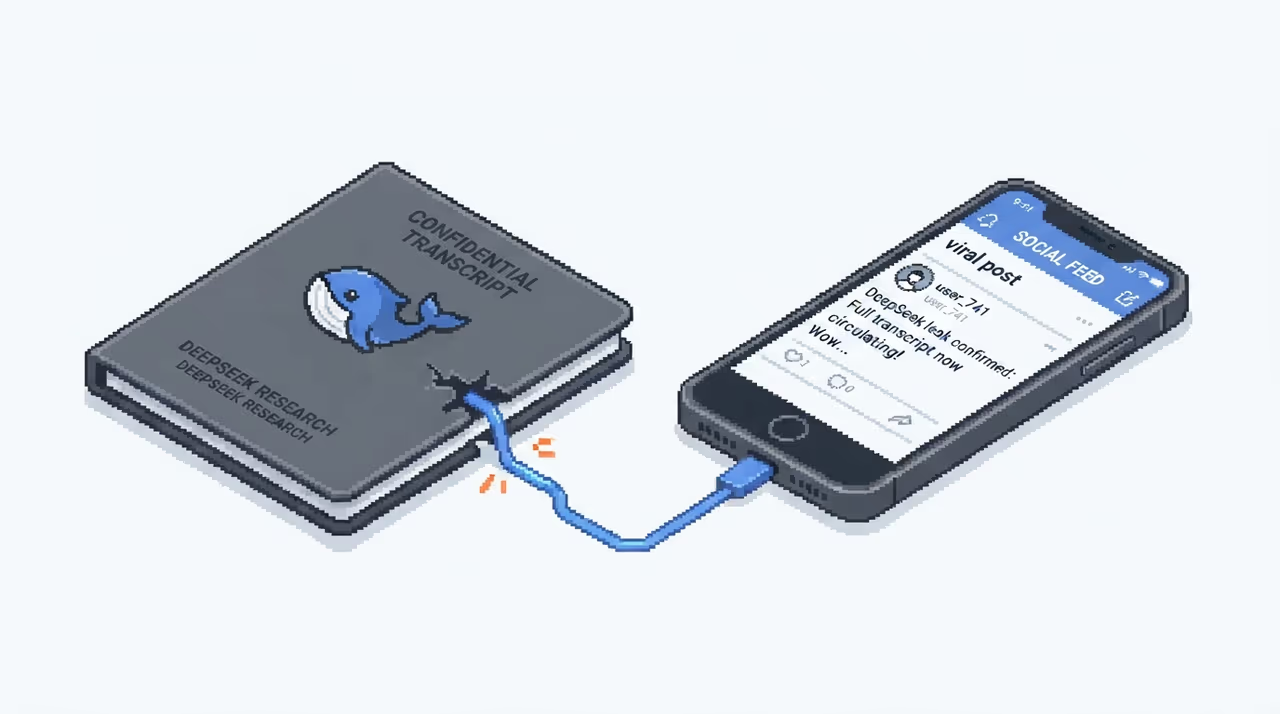
In May, DeepSeek founder Liang Wenfeng sat down with the investors backing the company's first-ever outside funding round and spent nearly four hours answering questions. A translated transcript of that closed-door meeting surfaced online in late July, spread across Weibo and Chinese tech outlets, and within days DeepSeek told prospective backers it would pause signing any new fundraising agreements.
- May (closed-door investor meeting)
- Late July (transcript posted, goes viral)
- ~July 25 (DeepSeek pauses fundraising)
Multiple outlets frame the pause as Liang's personal anger that confidential remarks got out, since the moderator had explicitly told attendees not to circulate figures or recordings. DeepSeek has not confirmed the transcript's authenticity, but investing institutions reportedly told a Chinese state outlet the meeting was real and the content accurate, and the granular Huawei and CUDA detail struck outside analysts as hard to fake.
The valuation and the drama are the headline. The part worth reading is what Liang told the room about compute: specific chip counts, specific gaps, and a blunt admission of how far DeepSeek actually is from the frontier.
The numbers
20,000 chips, and still short of the frontier
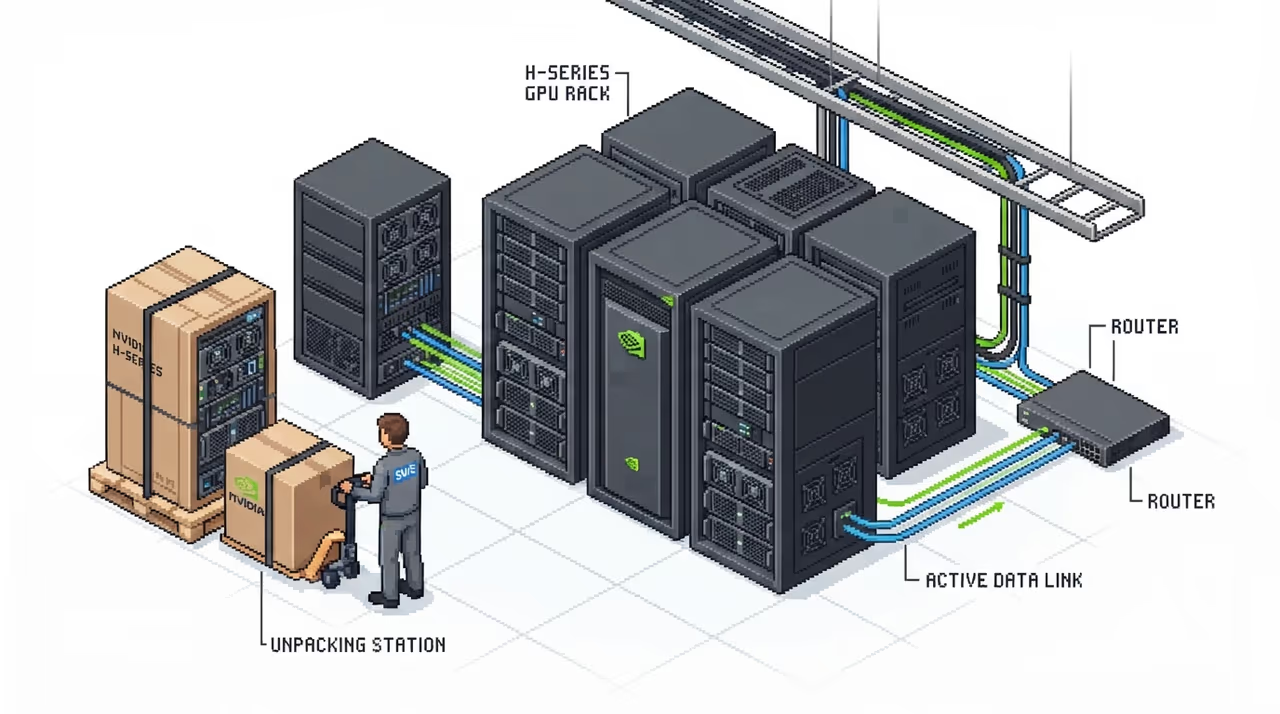
By Liang's own account, DeepSeek runs on roughly 20,000 Nvidia H-series-equivalent processors, much of it only recently installed. His plain conclusion: even pouring ¥50 billion (~$7bn) into chips would not let them train a model at true US frontier scale.
DeepSeek today:  ~20,000  H-series   ▓▓
Frontier run:    ~50,000  GB300      ▓▓▓▓▓
      or        ~200,000  Ascend 950 ▓▓▓▓▓▓▓▓▓▓▓▓▓▓▓▓▓▓▓▓

(...before counting the many smaller trial runs)He pegged Chinese developers at 1 to 2 years behind their US counterparts while working with about 1/20th the compute. On that hardware, he argued, China can win narrow tasks through engineering efficiency but cannot reach broad superiority. His stated purchasing wish was simple: B200s worth buying in any quantity at a fair price, and convert whatever capital is available straight into GPUs.
The best thing would be to turn all the money into cards.
The most sensitive line in the whole transcript is one throwaway remark: "For us, we can buy some noncompliant cards." No chip model, supplier, or route is named, and nothing in the sourced material ties it to any specific export-control finding, so treat it as exactly what it is: unconfirmed and unelaborated.
The domestic option
Four Huawei chips to match one Nvidia
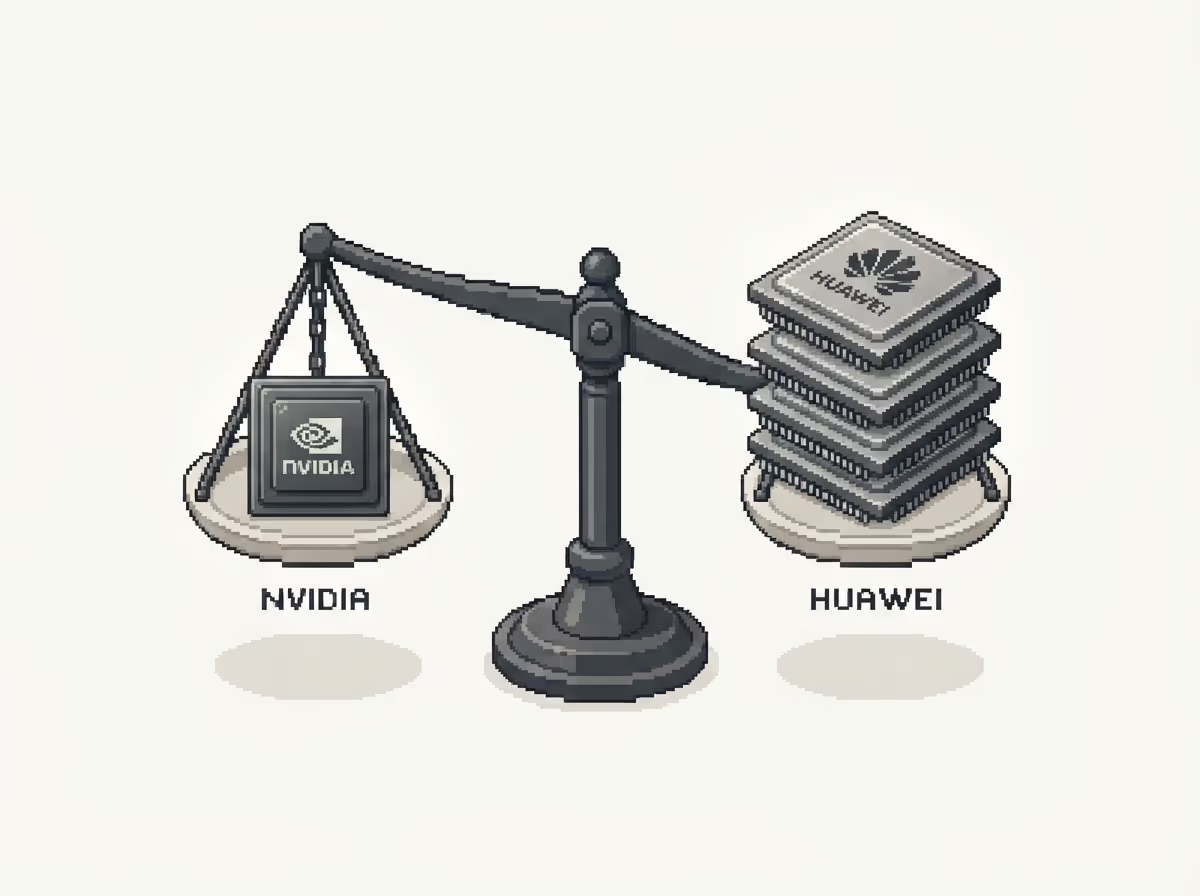
The domestic fallback does not close the gap. Huawei allocated DeepSeek about 16,000 Ascend 950 processors, against the hundreds of thousands going to China's big internet firms. By Liang's own math that allocation is worth only around 4,000 Nvidia B-series chips, because roughly 4 Huawei processors equal 1 Nvidia in usable compute.
Nvidia
~5-year useful life
Huawei Ascend
~3 years, pricier to run
Liang said the Huawei chips cover DeepSeek's current model generation but not the next one, and that he buys them partly to help Huawei's hardware-plus-software stack mature. The longer-term play is a software layer that moves models across Nvidia, Huawei, and other silicon to cut CUDA lock-in. He reportedly claimed V3 was trained "barely relying on CUDA," with GPU operators rewritten in DeepSeek's in-house TileLang, and that AI-assisted coding is steadily eroding Nvidia's software moat.
Why it stopped
A leak, then the brakes
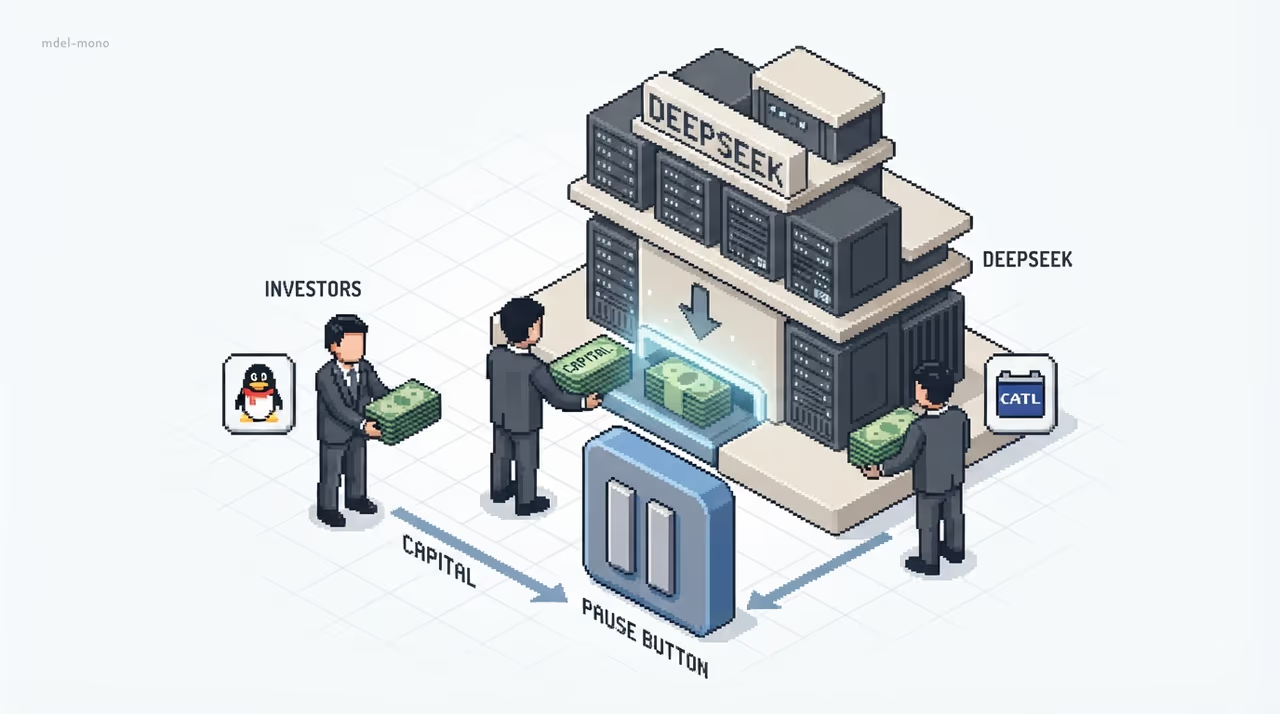
This was the meeting for DeepSeek's first external raise ever. Until now the company had run on Liang's own hedge-fund capital, having held a public line of no fundraising, no IPO, no commercialization. The round pulled in roughly ¥50 billion (~$7.4bn) at a valuation near $50-54bn.
First external round — ~¥50bn (~$7.4bn)
  Liang Wenfeng      ¥20bn
  Tencent            ¥10bn
  CATL               ¥5bn
  NetEase            ¥3bn
  JD.com             ¥3bn
  IDG Capital        ¥3bn
  National AI Fund   ¥1bn
A second round was reportedly in early talks at a pre-money valuation near ¥480bn (~$71bn) when the transcript leaked. DeepSeek then verbally told backers no deals would be signed in the near term. Notably, Liang himself frames restraint as strategy rather than weakness, so the pause reads less as a crisis than as the company doing what it says it does.
The other wall
Half the researchers are cleaning data
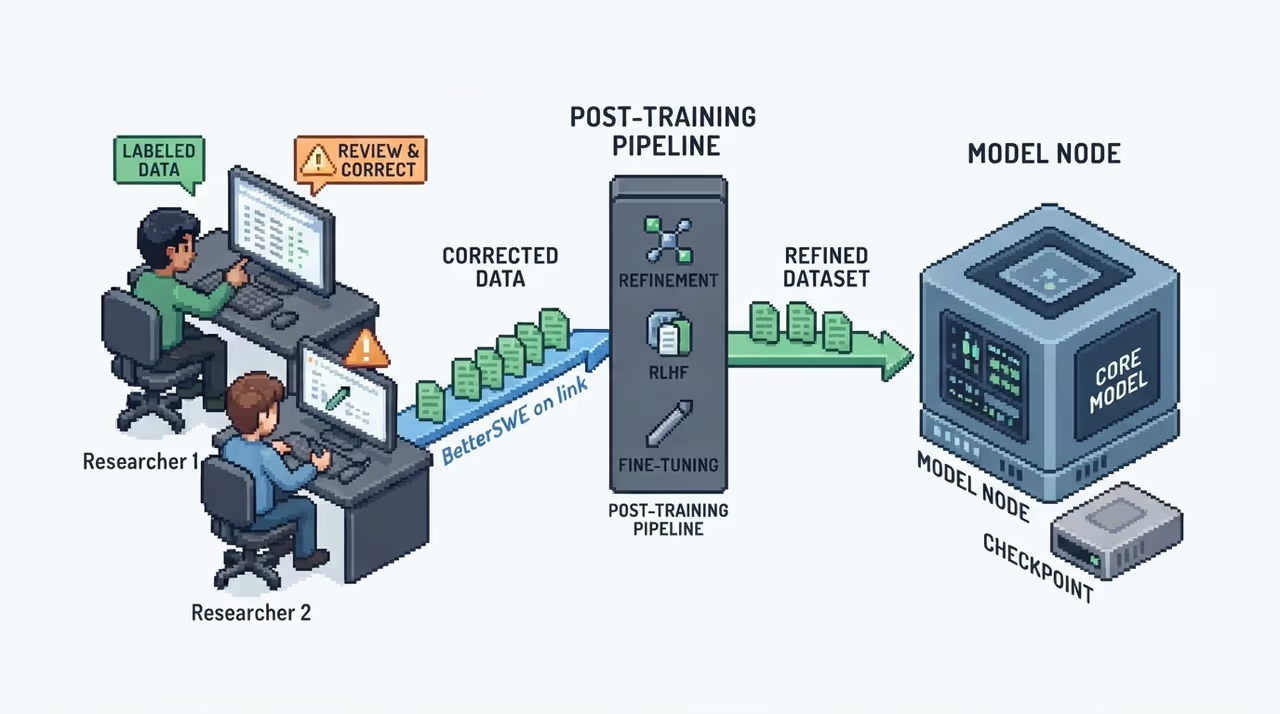
Compute is not the only bottleneck Liang named. He said roughly half of DeepSeek's core researchers work on data annotation, reviewing and correcting post-training data by hand. His claim: OpenAI and Anthropic have built a lead in high-quality post-training data that money cannot quickly buy, and DeepSeek's capital structure cannot support the kind of expensive labeling US labs run.
Chain-of-ThoughtAgentsContinuous learningSingularityEmbodied AI
On the roadmap, Liang put agents as this year's step, with coding agents as the top priority for China, and deprioritized 3D, video, and world models as off the main path to AGI. He also reaffirmed that DeepSeek will keep open-sourcing, saying even its most advanced models will eventually be released.
The takeaway
A rare look inside the constraint
Why it matters
It is rare to hear a frontier-lab founder say out loud that compute, not talent or algorithms, is the binding constraint. Liang's own numbers line up with the argument export-control hawks in Washington have been making: hardware access, not cleverness, sets the ceiling. That makes DeepSeek's cross-hardware and CUDA-alternative work the thread engineers should actually watch, because it is where a compute-starved lab is spending its ingenuity.
The short version
- A leaked transcript has DeepSeek's founder putting China **1-2 years behind** the US on AI while running about **1/20th** the compute.
- DeepSeek runs on ~20,000 H-series-equivalent chips; Liang says a frontier training run would need ~50,000 GB300s or ~200,000 Huawei Ascend 950s.
- Huawei's allocation is real but small (~16,000 chips, ~4-to-1 worse than Nvidia) and only covers the current model generation.
- The company **paused** its second raise after the leak, and DeepSeek has not confirmed the transcript is genuine.
- The real technical bet is software that ports models off CUDA and across Nvidia, Huawei, and other silicon.
Sources
- 2.DeepSeek Pauses Fundraising After Founder’s Remarks Leaked | The Epoch Times
- 3.DeepSeek's Leaked Investor Call: The Full AI Playbook
- 4.Alleged Leaked Transcript of DeepSeek CEO: 118 Answers on His Roadmap
- 6.[China Watch] DeepSeek Meeting Minutes Leak Triggers Shockwaves: The Reality Behind China’s \"AI Rise\"
- 7.DeepSeek pauses fundraising after founder's leaked comments go viral
- 8.what leaked comments reveal about DeepSeek's Liang Wenfeng
- 9.DeepSeek Halts Second Fundraising Following Founder's Leaked Comments on China's AI Gap
- 10.DeepSeek hits the brakes on mega-funding after founder’s leaked reality check
- 15.Luiza Jarovsky, PhD on X: "🚨 In a leaked call transcript, we learn what DeepSeek's CEO thinks are China's weaknesses and strengths in the AI race with the United States: Today, a call between DeepSeek's founder and CEO, Liang Wenfeng, and a group of investors was leaked. A few hours after the leak, the WeChat links referring to this call had been removed from the internet. It is still unclear whether the Chinese government ordered it due to political, economic, or regulatory risk, or whether it was a private removal request. My guess is that it was a private request, but the Chinese government is glad it was removed. To my knowledge, similar leaks had never happened before. Remarkably, what DeepSeek’s CEO says is similar to what Anthropic's Dario Amodei said in 2025 and reiterated this year: compute is the most important bottleneck in the AI race between China and the U.S. (According to this view, export controls are probably an effective way to curb Chinese competition in AI). I selected 11 excerpts that reflect DeepSeek’s CEO's thoughts on China's weaknesses, strengths, and its competition with the U.S.: 1. DeepSeek lacks resources 2. The talent gap is due to the compute gap 3. “We’re still at tens of billions—an order of magnitude difference” 4. “Huawei’s production is limited” 5. “About half of our people think OpenAI is better” 6. “NVIDIA is digging its own grave” 7. “We don’t maximize profit or price for maximum revenue” 8. “Our gap with the U.S. might be (...) roughly two years, but using one-twentieth the compute” 9. “I see no upper limit to language model scaling” 10. “Our capital structure can’t support high-cost labeling like that of the U.S.” 11. “In China, the most reasonable approach seems to be to focus on general Agents, with Coding Agent as the top priority” Check out the full excerpts in the link below *AI policy professionals (especially U.S. ones): don't miss this edition! 👉Link below." / X