News · Issue 11
Cursor's Vanishing Price Tag: Why an AI Code Editor Pulled Its Own Cost Data
In about a year Cursor changed how it charges three times, and each step made the true cost of a single request harder to see.

The change
The Model Behind the Curtain

One line in Cursor's changelog for its new Router does a lot of quiet work: the routed model "can be displayed or hidden," and hidden is the default. When you fire off a coding request now, an intelligent router picks the underlying model for you, and by default you never see which one answered.
Your promptCursor Router??? (hidden model)
That default is the last step of a three-part journey. Cursor has changed how it bills for AI roughly three times in a year, and each change made the real cost of a single request harder to see: first a fixed quota you could count, then volatile token metering, now a router that hides the very model whose rate you're paying.
Paradigm 1
When a Request Was Just a Request
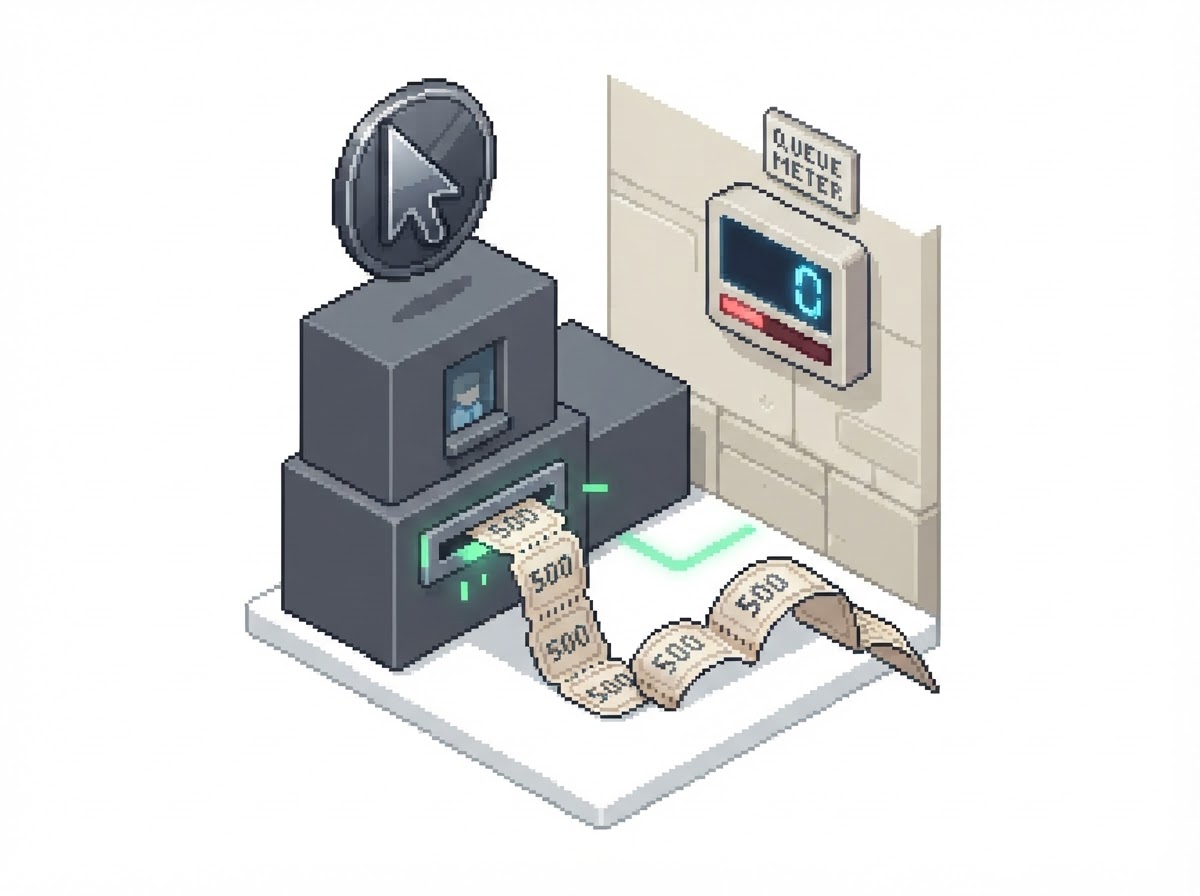
Before June 2025, Pro cost $20/month and handed you 500 fast premium requests. One prompt to a premium model burned one request. You could count them on one hand at a glance, and staff had earlier anchored the internal figure at roughly $0.04 per request.
Fast premium requests this month
[################........] 340 / 500 used
 one prompt  =  one tick, regardless of size
The catch was baked in from the start. A heavy multi-file refactor and a one-line tweak both cost "one request," so Cursor absorbed the variance itself. That is exactly why the model couldn't hold: the hardest requests cost far more to serve than the simplest, and a flat quota buries that gap.
Paradigm 2
The $20 Pool That Drained in a Day

On June 16, 2025, Cursor swapped the 500-request quota for a $20 pool of usage credits billed at the underlying model's live API rates, and added a $200/month Ultra plan. Auto mode was pitched as "unlimited," but only Auto was, and that limit wasn't spelled out clearly to users.
- Jun 16 (Quota becomes a $20 usage pool)
- Jun 30 (Blog and pricing page updated for clarity)
- Jul 4 (Public apology, refunds offered)
People watched their pools evaporate. Secondhand reports described one user going from about $28/month to $500 in three days, and another burning the whole $20 plus $18 in overage in a single day. Predictable monthly spend had turned into a live meter nobody could read in advance.
On July 4, 2025, Cursor admitted the changes "were not communicated clearly," called it "our mistake," and offered refunds for surprise charges racked up between June 16 and July 4.
The numbers underneath
Visible, and Still Impossible to Predict

The new scheme did surface real numbers. Auto billed roughly $0.25 per million cached tokens, $1.25 per million input, and $6 per million output. On paper you could sit down and compute what a request would cost.
In practice you couldn't, because you never know the inputs ahead of time. Cost rides on how much context the agent pulls in and how long the model reasons, so two prompts that look identical diverge sharply. Staff said the hardest requests run an order of magnitude more than simple ones, and credits burn at the same rate as calling the APIs directly.
Paradigm 3
The Router That Hides the Rate
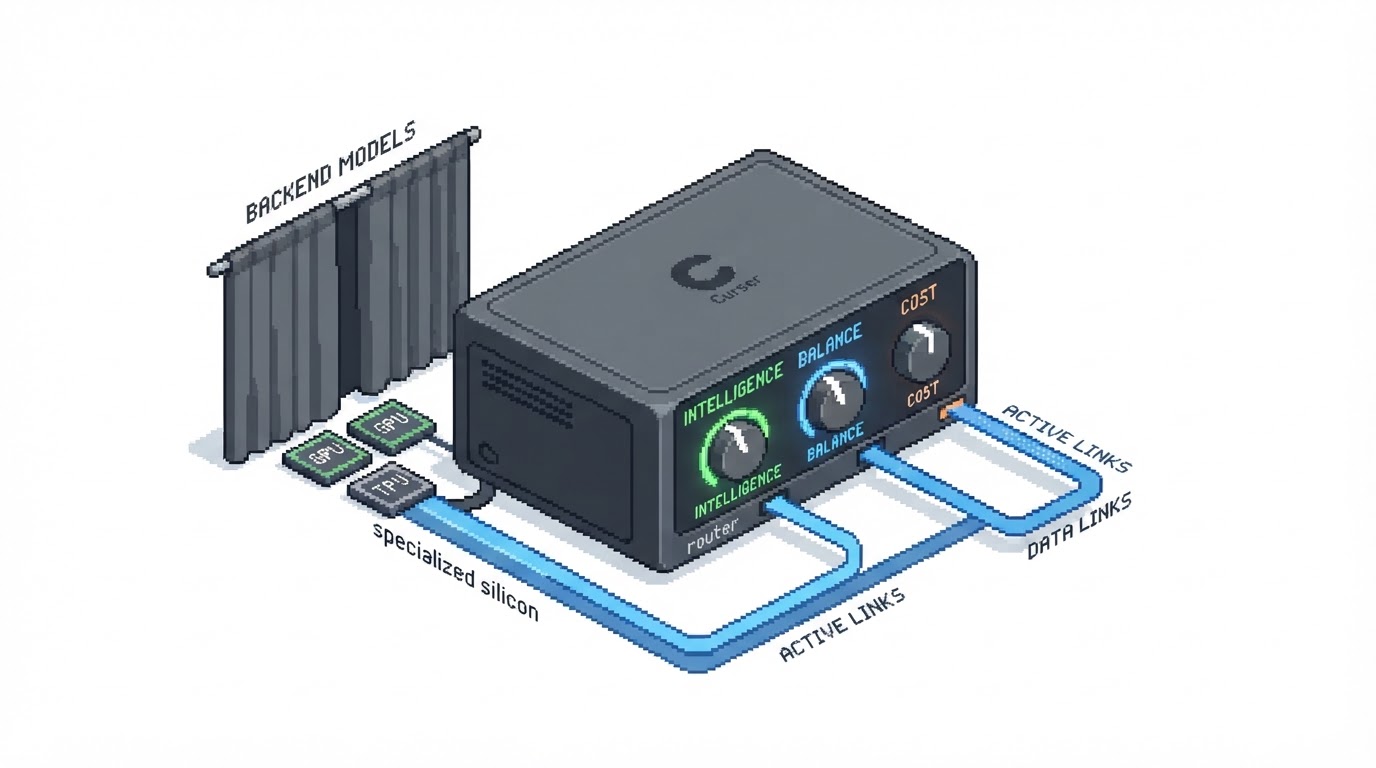
The Router closes the loop. Cursor pitches it as "frontier-quality results at 60% lower cost," reaching for a cheaper model when the task doesn't need the best one. It runs three modes, Intelligence, Balance, and Cost, and Balance and Intelligence both bill at whatever the routed model's rate happens to be.
Router mode
- Grok 4.5 (price-efficient)
- Frontier model (top quality)
- Cursor's own (Composer / Auto)
So your bill now depends on a model the app selects and, by default, doesn't name. Router is on by default for Teams, and admins can force the model to display, restrict modes, or block specific models, but the individual developer sees a hidden pick. Core features like Tab and Apply always run on Cursor's own models too, so you can't route them to your own API key even when you'd rather own the cost.
The takeaway
Cheaper Bills, Fewer Answers
Why it matters
Cursor's pricing keeps tracking the raw economics of AI coding, where a single request's cost can swing tenfold and a flat monthly quota simply can't survive. The Router genuinely lowers bills, but it does so by hiding which model, and therefore whose token rate, is handling your work. Teams now watch their spend ride on routing decisions that stay invisible unless an admin switches display on, which is the shape metered AI tools are drifting toward.
The short version
- Cursor has moved through **three pricing models** in about a year, each one making a request's true cost less visible.
- The **June 16, 2025** switch from 500 requests to a **$20 usage pool** triggered surprise bills and a **July 4** apology plus refunds.
- Per-token rates were published, but cost still varied by **~10x** with context and reasoning length, so it stayed unpredictable.
- The **Router** hides the chosen model by default and bills at that model's rate, so you often can't see whose price you're paying.
- Tab and Apply always run on Cursor's own models, so you can't shift their cost to your own API key.